
Place Betting Horse Racing: Terms, Odds and Payout Guide
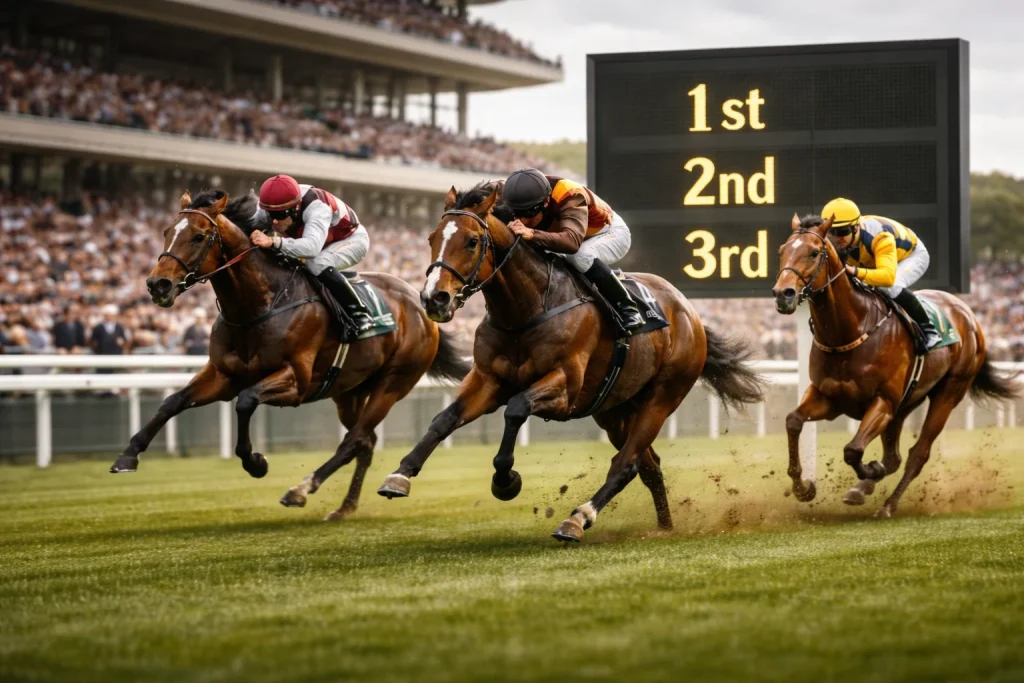
A place bet strips away the need for your horse to win outright. Finish in the designated places—usually the top two, three, or four depending on field size—and the bet pays out. It’s simpler than each-way because there’s no win component to consider, and it offers a distinct proposition when you’re confident a horse will be competitive without being certain it can actually win.
Place-only betting differs fundamentally from the place part of an each-way wager. With each-way, you’re effectively making two bets: one on the horse winning and one on it placing. A place-only bet puts everything on the frame finish, at odds specifically calculated for that outcome. The payouts work differently, the value calculations differ, and the strategic considerations diverge.
This guide explains how place terms vary by race type, how to evaluate place odds against each-way alternatives, and where genuine place value hides in UK racing markets. Sometimes the place bet is exactly the right tool—but knowing when requires understanding how the mechanics actually work.
How Place Bets Work
Standard place-only markets offer odds derived from—but not simply fractions of—win odds. A horse at 10/1 to win might be available at 2/1 or 5/2 for a place, depending on the bookmaker’s assessment of the race’s competitive structure. These aren’t automatic calculations; bookmakers adjust place odds based on perceived probabilities of different finishing positions.
The number of places paid depends on field size. In races with 5-7 runners, bookmakers typically pay the first two places. Eight or more runners usually triggers three-place terms. Handicaps with 16 or more runners often pay four places. These thresholds align broadly with each-way terms but can vary between operators and promotions.
Unlike each-way place odds—which are declared as a fraction of the win price (1/4 or 1/5 odds)—place-only markets price the place finish independently. This independence creates opportunities. If a bookmaker’s win odds are tight but their place market hasn’t adjusted proportionally, the place-only price might offer better value than the place portion of an each-way bet would.
Calculating returns mirrors win bet arithmetic. At place odds of 3/1 (4.00 decimal), a £10 bet returns £40 if the horse finishes in the places. At 5/4 (2.25 decimal), the same stake returns £22.50. The stake always returns alongside the profit, assuming your horse makes the frame. Fall outside the paying places, and the bet loses entirely.
Dead heats in place positions reduce payouts proportionally. If two horses tie for third in a race paying three places, place bets on both are settled at half-stake. A £10 bet at 3/1 in that scenario returns £20 rather than £40—half the stake (£5) multiplied by the odds (3), plus the winning £5 portion of the original stake.
Place Terms by Race Type
Field sizes directly determine how many places bookmakers will pay. The BHA Racing Report 2026 shows average field sizes of 8.90 for Flat races and 7.84 for Jumps—down from 9.14 and 8.49 respectively the previous year. These averages mean most races fall into three-place territory, though significant variation exists across race types.
Handicaps routinely draw larger fields than conditions races. A Saturday afternoon handicap at a premier meeting might attract 16-20 runners, triggering four-place terms. A midweek novice hurdle might field six or seven, limiting payouts to two places. The competitive dynamics differ entirely, and your place betting approach should reflect those differences.
Festival meetings amplify field sizes and promotional generosity. Bookmakers competing for Cheltenham or Royal Ascot business often extend place terms beyond standard thresholds—paying five or six places on flagship handicaps, or offering “extra places” promotions on selected races. These enhanced terms shift the value equation significantly, making place bets more attractive when they might otherwise be marginal.
Smaller fields demand caution. In a five-runner race paying only two places, you’re asking for a top-two finish—a tougher ask than the phrase “place bet” might suggest to beginners. The horse essentially needs to beat at least three others, which in a field dominated by two short-priced runners, might still be unlikely for your selection.
Jump racing generally produces smaller fields than Flat racing, reflecting the smaller horse population trained for National Hunt competition. This structural difference affects place betting strategy: fewer runners means fewer places paid, which in turn means place bets carry more risk relative to their Flat equivalents in comparable race types.
Place-Only vs Each-Way
Each-way betting commits you to two bets: win and place. At £10 each-way, you spend £20 total. If the horse wins, both parts pay. If it places without winning, only the place portion returns. If it misses the frame entirely, everything is lost. The mathematics can work for or against you depending on the odds and your confidence in the selection.
The prize-money landscape shapes betting patterns. As Richard Wayman of the BHA noted, prize-money on Premier Racedays in 2026 was over £7 million higher than the previous year. Bigger prizes attract better fields, which can make place finishes more valuable from a betting perspective when you’re uncertain about winning outright but confident in competitiveness.
Place-only betting sidesteps the win component entirely. You’re not paying for something you don’t want—if your analysis suggests placing rather than winning, why fund a win bet at all? The stake efficiency argument favours place-only when your confidence specifically centres on the horse being competitive without necessarily prevailing.
The comparison becomes concrete with numbers. A 10/1 shot each-way at £10 costs £20 total. If the horse places, you collect the place portion at 1/4 odds: £10 at 5/2 returns £35. Net result: +£15 on the day. A place-only bet at 5/2 (if that price is available) requires only £10 to achieve the same £35 return. Net result: +£25. The place-only route delivers £10 more profit for the same outcome—assuming, crucially, that the place-only odds match what each-way terms would give you.
The catch is that dedicated place markets sometimes price conservatively. A horse at 10/1 win with 1/4 place terms implies 5/2 for the place—but the actual place-only market might offer only 2/1. In that scenario, each-way becomes the better proposition despite tying up more capital. Always compare before committing.
Finding Place Value
Genuine place value often emerges from specific horse profiles. Consistent placers—horses that routinely finish second or third but rarely win—are the obvious candidates. Their win odds might be inflated by poor win records, while their place chances remain solid. The market knows they struggle to win, but sometimes overcorrects, leaving place odds too generous.
Racecourse attendance rose to 5.031 million in 2026—the first time above five million since 2019, representing a 4.8% increase on 2026. Growing crowds at major meetings mean more money flowing into betting markets, which can create inefficiencies in subsidiary markets like place betting. The most liquid markets (win, big handicaps) get the sharpest pricing; less-traded place markets on smaller races may harbour value longer.
Tactical runners suit place betting too. Front-runners in staying races sometimes set strong paces that see them weakening late but hanging on for minor honours. Closers from off the pace sometimes run on past tired leaders without quite getting up. Identifying these patterns in horses’ racing styles helps predict place finishes even when winning seems unlikely.
Field composition matters as much as your horse’s ability. A race with two standout contenders and an even middle group creates different place probabilities than an open handicap where ten horses have similar chances. In the former, your mid-priced selection might be genuinely fighting for one place spot; in the latter, that same horse might have multiple realistic routes to the frame.
Compare place-only prices across multiple bookmakers. The place market is thinner than the win market, meaning individual bookmakers’ opinions vary more. One firm’s 5/2 might be another’s 3/1. That 20% difference in implied probability translates directly to your bottom line.
Place betting occupies a useful niche between win-only conviction and each-way hedging. It suits horses you trust to be competitive but doubt can win, situations where paying for a win bet feels like wasted money, and races where place-only odds offer better value than equivalent each-way terms.
The key lies in rigorous comparison. Check both place-only markets and each-way alternatives before betting. Calculate the returns each route delivers for your likely outcome. Choose the option that maximises profit for the scenario you expect—not the one that sounds simpler or more familiar. Place betting rewards the punter willing to do that arithmetic.