
Win Betting on Horse Racing: Odds, Stakes and Payouts
 Available in US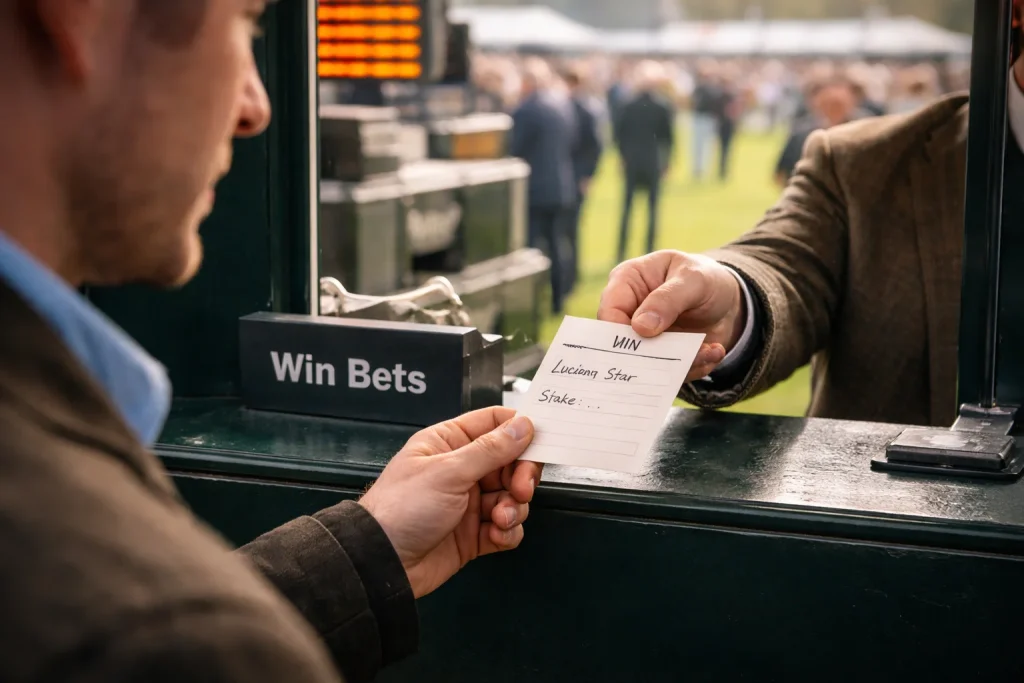
Before exploring each-way wagers, accumulators, or exotic bets like forecasts and tricasts, you need to understand how a basic win bet functions. The mechanics are universal across every UK bookmaker—stake multiplied by odds determines your profit—and once you’ve grasped this, everything else in racing betting becomes an extension of the same core principle.
This guide walks through the fundamentals: how returns are calculated, when a straight win bet makes more sense than an each-way, what odds-on prices really mean, and how to place your first wager with confidence. Start simple, bet to win.
Win Bets on UK Racing: Fixed Odds Mechanics
A win bet requires one outcome: your selected horse crosses the finish line first. Nothing else matters for settlement purposes. Second place pays nothing. Third is irrelevant. The horse must win the race outright—or share first in the rare event of a dead heat—for your bet to return anything.
Calculating returns depends on whether you’re reading fractional or decimal odds. With fractional odds like 4/1, multiply your stake by 4 to find your profit, then add your stake back. A £10 bet at 4/1 returns £50 total (£40 profit plus your £10 stake). At 7/2, that same £10 returns £45—£35 profit from the multiplication (10 × 3.5) plus your original tenner.
Decimal odds make the arithmetic even more direct. The displayed number represents your total return per pound staked. At decimal odds of 5.00, a £10 bet returns exactly £50. At 3.50, you receive £35. There’s no need to add the stake separately because decimal odds already include it. If you see 5.00 and stake £10, you know the answer instantly: £50 if the horse wins, nothing if it loses.
Consider a practical afternoon. Three races catch your attention. You back horses at 3/1, 5/2, and 9/4 with £10 each—£30 total committed. If the 3/1 selection wins, you collect £40 (£30 profit plus £10 stake). The 5/2 shot would bring £35 (£25 plus £10). The 9/4 pick returns £32.50 (£22.50 profit plus stake). One winner from three doesn’t guarantee overall profit, but understanding exactly what each outcome delivers helps you manage expectations and bankroll alike.
Dead heats occasionally complicate matters. If two horses finish in a genuine tie for first—photo finishes sometimes produce this result—your bet is settled at half-stake on the declared odds. A £10 bet at 4/1 in a two-way dead heat returns £25: half your stake (£5) multiplied by 4, plus the £5 stake portion that won. The other half of your stake is lost.
Choosing Win vs Each-Way
Each-way betting splits your stake between a win bet and a place bet. It costs twice as much—a £10 each-way wager is actually two £10 bets, £20 total—but offers a return if your horse finishes in the places without winning. The question is when this safety net justifies the extra outlay.
Statistics show favourites win approximately 30-35% of all races. If you’re backing market leaders at short prices, the win portion is where most of your value typically lies. An each-way bet on a 2/1 favourite, where the place part pays at 1/5 odds (industry standard), delivers minimal compensation for second or third. You’d need to hit enough winners to justify the doubled stake, and at short prices, that mathematics often works against you.
Win-only betting makes particular sense when you’re confident in a selection. If your assessment puts a horse’s true winning chance higher than the implied probability of the odds, doubling down on that conviction with a win bet extracts maximum value from your edge. Splitting the stake into each-way dilutes the profit when your confident selections actually deliver.
The calculus shifts at longer prices. A 10/1 outsider with each-way terms of 1/4 odds for places pays 5/2 for a place finish. If you believe the horse will hit the frame more often than those place odds imply, each-way offers genuine value. But if your edge is specifically about the horse winning—perhaps you’ve spotted something the market has missed—a win-only approach puts all your money where your conviction lies.
Field size matters too. Races with five or fewer runners typically pay only two places; many big-field handicaps pay four. The more places paid, the better the each-way safety net becomes. For short-priced horses in small fields, win betting almost always represents the sharper play.
Understanding Odds-On
Odds-on prices indicate a horse is more likely to win than lose, at least in the market’s estimation. At 1/2, you stake £2 to win £1 profit. At 4/9, you risk £9 for £4 profit. The decimal equivalents—1.50 and 1.44 respectively—show total returns below twice your stake, confirming the odds-on status.
Backing odds-on selections regularly requires a high strike rate to generate profit. At 1/2 (implied probability around 67%), you need to win more than two out of every three bets just to break even. At 1/4 (80% implied), you must win four of five. Miss one too many, and the losing bets quickly erode accumulated profits.
This doesn’t mean odds-on bets lack value—some genuinely exceptional horses deserve their short prices—but the mathematics demand discipline. A 1/3 shot that wins 85% of the time still represents value; a 1/3 shot winning only 70% of the time is a slow leak in your bankroll. The problem is distinguishing one from the other, and that distinction requires genuine form analysis rather than blind faith in market pricing.
Many successful punters avoid odds-on ranges entirely, preferring the margin for error that longer prices provide. Others specialise in identifying false favourites—horses priced shorter than their true chances justify—and opposing them. The key is understanding what you’re signing up for when backing anything below evens: high probability of success, but thin margins and severe punishment for failures.
Placing Your First Win Bet
Opening a betting account takes minutes. UK-licensed bookmakers require identity verification—usually a driving licence or passport—and must comply with responsible gambling regulations. The UK Gambling Commission’s April-July 2026 data shows 7% of adults had bet on horse racing in the previous four weeks, making it one of the country’s most accessible forms of gambling. That accessibility comes with obligations on both operator and punter to keep things sensible.
Once registered and verified, navigate to the horse racing section. Racecards display each day’s meetings, with individual races expandable to show the runners, their odds, and form information. Study the card before betting. Note the going (ground conditions), each horse’s recent results, and any trainer or jockey patterns that catch your eye.
To place a bet, click or tap on the odds next to your chosen horse. The selection appears in your bet slip—usually on the right side of the screen or as a pop-up on mobile. Enter your stake, confirm the bet type is “win” (not each-way), and review the potential returns displayed. When satisfied, confirm the bet. Most bookmakers immediately lock in your odds, though some offer SP (starting price) as an alternative.
Start with stakes you’re entirely comfortable losing. The purpose of early bets is education as much as profit—learning how markets move, how your selections perform, and how the whole process feels in practice. A £2 or £5 bet teaches the same lessons as a £50 wager, with far less at risk. Build your understanding before building your stakes.
Track your bets from the beginning. Note what you backed, at what odds, and whether it won or lost. Review these records weekly. Patterns emerge: perhaps you consistently overestimate certain trainers, or your morning prices beat your afternoon selections. This data becomes invaluable as you refine your approach.
From this foundation, every other bet type becomes accessible. Each-way betting adds a place component. Accumulators chain win bets together. Forecasts and tricasts extend the challenge to predicting multiple finishers. But they all rest on the same basic calculation: odds multiplied by stake equals potential profit. Master that relationship here, and the rest follows naturally.
