
Dead Heat Rules in Betting: How Ties Affect Your Payout
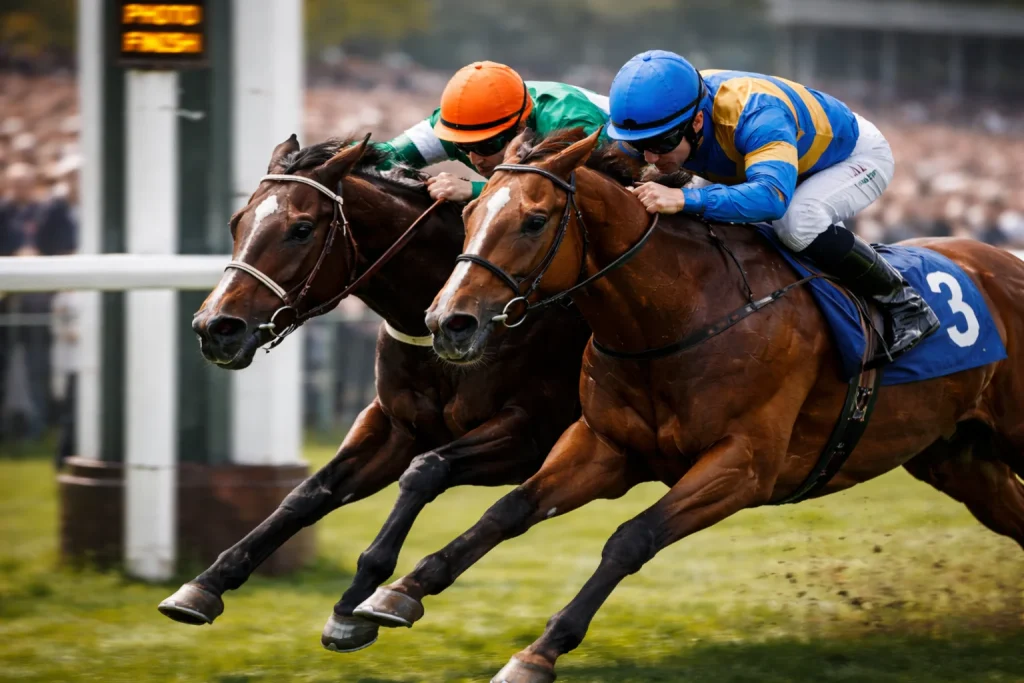
A dead heat occurs when two or more horses finish in an exact tie that photo-finish technology cannot separate. Rather than declare multiple winners, bookmakers apply dead heat rules that divide your potential returns between the tied horses. Your selection won—but so did another, and that sharing reduces your payout.
Dead heats aren’t common, but they happen often enough that every serious punter eventually encounters one. The settlement mechanics can surprise those unfamiliar with the rules, particularly in each-way betting where both win and place components might be affected by tied finishes at different positions.
This guide explains how dead heats are declared, how bookmakers calculate reduced payouts, and what happens when dead heats affect each-way bets. Understanding these rules before they apply prevents confusion when settlement occurs—and removes the temptation to blame bookmakers for following standard industry procedures.
How Dead Heats Occur
Photo-finish cameras capture thousands of frames per second, measuring distances between horses’ noses at the finish line to extraordinary precision. Despite this technology, genuine dead heats still occur—situations where the camera literally cannot detect any difference between finishing positions. The judge examines the image and declares a dead heat when separation is impossible.
Dead heats happen more frequently in large fields where multiple horses converge at the line. The BHA Racing Report 2026 recorded racecourse attendance of 5.031 million—the first time above five million since 2019, representing a 4.8% increase on the previous year. More racing and bigger crowds mean more opportunities to witness dead heats, though they remain relatively rare events even across a full season.
Two-horse dead heats are most common. Three-way or larger ties are extremely rare but do occur. The dead heat rules apply regardless of how many horses share the position—your stake is simply divided by the number of horses involved in the tie.
Dead heats for places operate identically to dead heats for wins. If two horses tie for third in a race paying three places, both are deemed to have finished third and dead heat rules apply to place bets on either horse.
Dead Heat Calculation
The dead heat formula is straightforward: divide your stake by the number of horses sharing the position, then calculate returns on that reduced stake at full odds. For a two-horse dead heat, half your stake wins at the original odds; the other half loses. For a three-way tie, one-third of your stake wins; two-thirds are lost.
Consider a £10 win bet at 6/1 in a two-horse dead heat. Your £10 stake becomes two £5 portions. One £5 wins at 6/1, returning £35 (£30 profit plus £5 stake). The other £5 is lost. Your total return is £35 from a £10 investment—£25 profit rather than the £60 profit you’d have received from an outright win.
The decimal odds calculation works identically. At 7.00 (equivalent to 6/1), a £10 stake in a two-horse dead heat returns £35: half the stake (£5) multiplied by the decimal odds (7.00). The mathematics are the same; only the notation differs.
Three-way dead heats reduce returns more severely. That same £10 at 6/1 becomes three £3.33 portions. Only one-third wins: £3.33 × 7.00 = £23.31. From your £10 stake, you receive £23.31 back—a modest profit rather than the life-changing win you might have anticipated. The more horses in the dead heat, the more your returns shrink.
Place-only dead heats follow identical logic. If you backed a horse at 3/1 for a place and it dead-heats for third with one other horse, half your stake wins at 3/1 and half loses. The position dead-heated doesn’t affect the calculation—only the number of horses sharing that position matters.
Accumulators face compounded dead heat effects. If one leg of a four-fold finishes in a dead heat, the reduced return from that leg multiplies through subsequent selections. A dead heat early in an accumulator can substantially reduce final returns even if all other legs win outright.
Dead Heats in Each-Way Betting
Each-way betting involves two separate bets—win and place—and dead heats can affect either or both. The settlement depends on where the dead heat occurs and how many places the race pays.
If your horse dead-heats for first place, both your win bet and place bet are affected. The win portion settles at half-stake (assuming a two-horse tie) at full win odds. The place portion also settles at half-stake at place odds—because the horse placed as well as won. You receive reduced returns on both components.
If your horse dead-heats for a place position but didn’t win, only the place portion is affected. Your win bet loses entirely (the horse didn’t win), and your place bet settles under dead heat rules. This scenario often disappoints punters who expected a place return but receive only a reduced payout.
The broader industry challenges compound this complexity. As Martin Cruddace, Chief Executive of Arena Racing Company, observed: “There is overwhelming consensus across the industry… that further measures will decimate our sport that millions are passionate about.” While this quote addressed regulatory pressures rather than dead heats specifically, it reflects the challenging environment in which betting rules must operate clearly and fairly.
Dead heats affecting multiple place positions can create complex scenarios. Imagine a race paying three places where two horses tie for second and third. Both horses are deemed to have finished in a place position, but the dead heat rules apply to place bets on either. Additionally, this might affect horses finishing behind them—the fourth-placed horse might find itself in a place position for settlement purposes if the dead heat compresses the first three positions.
Living with Dead Heat Risk
You cannot prevent dead heats—they occur when two horses finish inseparably, regardless of your betting intentions. No form analysis, timing strategy, or stake sizing eliminates this risk. It’s an inherent feature of racing that occasionally affects your returns.
Field size influences dead heat probability marginally. Larger fields mean more horses converging at the finish, creating more opportunities for exact ties. Average field sizes have declined—8.90 for Flat and 7.84 for Jumps according to the BHA’s 2026 data—which theoretically reduces dead heat frequency slightly, though the effect is minimal.
The sensible approach is acceptance. Dead heats happen rarely, affect returns when they occur, and cannot be predicted or prevented. Factor this into your understanding of racing betting rather than treating it as an unfair outcome. The rules are applied consistently and impartially.
If a dead heat significantly reduces an anticipated large return, the disappointment is understandable. But your selection still won—partially. You still receive a return, often a profitable one despite the reduction. Perspective helps: many punters would happily accept a dead heat outcome if offered it before the race began.
Dead heat rules exist to handle situations where photo-finish technology cannot separate horses. The calculations are mechanical—divide stake, apply odds, return the result. Understanding these rules prevents confusion when they inevitably apply to your bets.
Each-way bets add complexity but follow the same principles at each stage. Win and place components settle independently, each potentially affected by dead heats at different positions. Knowing what to expect when the judge declares a tie makes the outcome easier to accept and the settlement easier to verify.