
Betfair Starting Price Explained: Exchange SP vs Industry SP
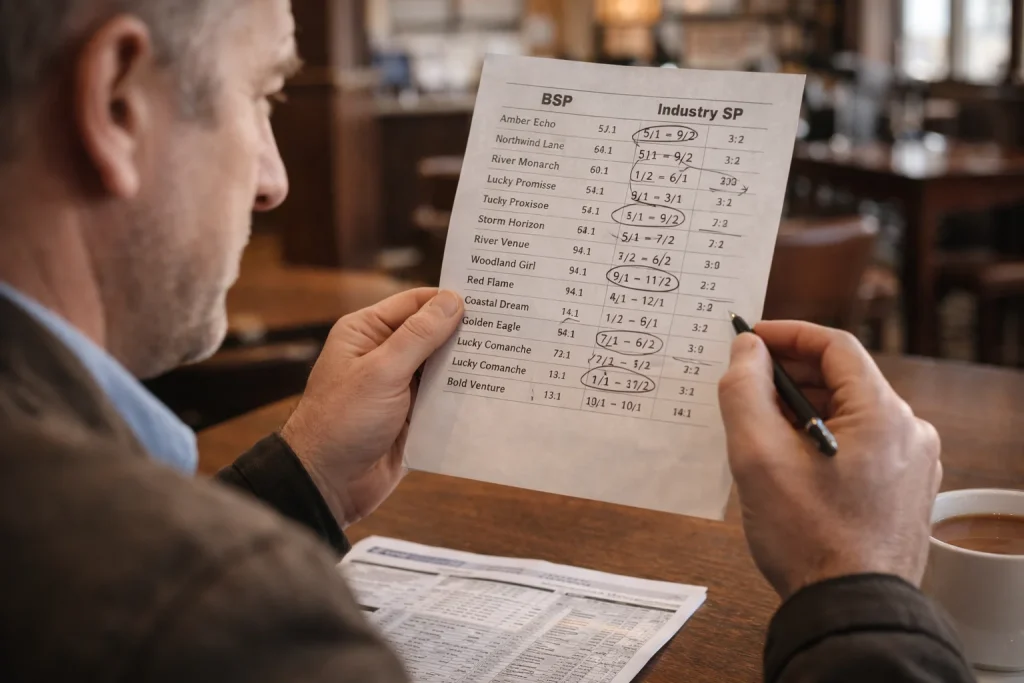
Betfair Starting Price offers an alternative to the traditional Industry SP that bookmakers use. Rather than relying on prices returned by on-course bookmakers, BSP calculates a starting price from the actual exchange market—the orders placed by thousands of punters backing and laying horses right up to the off. The result is typically a more accurate reflection of where money actually sits.
For punters who prefer not to take a fixed price but want something better than Industry SP, BSP provides a middle path. Request BSP on your Betfair bet, and you’ll receive whatever price the algorithm determines at race-off. The calculation isn’t arbitrary—it’s based on genuine market activity and available liquidity.
This guide explains how BSP works, compares its performance to Industry SP, and identifies when requesting BSP makes strategic sense. The data strongly favours BSP in most scenarios, but understanding the mechanism helps you deploy it effectively.
How BSP Is Calculated
BSP derives from the state of the Betfair exchange market at the moment a race begins. The algorithm examines all matched bets and unmatched orders sitting in the order book, then calculates a price that would clear the maximum volume if all that money were to transact. It’s essentially asking: at what price would supply and demand balance?
The calculation considers both sides of the market. Backers have placed orders at various prices, and layers have offered to take those bets at their own prices. Where these positions overlap, bets match. Where they don’t, orders sit waiting. BSP finds the equilibrium point that represents genuine market opinion at race-off.
Unmatched orders matter significantly. If substantial money sits ready to back a horse at 5.0 but hasn’t matched because no layer will accept that price, the BSP calculation still incorporates that demand. Similarly, large lay orders at specific prices influence the final figure. The algorithm captures latent demand and supply, not just completed transactions.
This differs fundamentally from Industry SP, which reflects prices offered by on-course bookmakers at the moment of race-off. Those bookmakers set odds based on their own liability management and market view, not on the aggregate positions of thousands of exchange participants. The exchange-based approach captures broader market sentiment.
BSP updates continuously until the race starts, then locks at the final calculated price. Any bets placed requesting BSP receive that figure. The commission charged on winning bets is then applied to your returns—a cost that doesn’t affect Industry SP users but factors into BSP value calculations.
BSP vs Industry SP
The statistical comparison between BSP and Industry SP is striking. Analysis from Geegeez examining 2023-2026 UK racing data found that Betfair Starting Price returns a higher price than Industry SP in 97.5% of cases. That’s not a marginal advantage—it’s near-universal outperformance across thousands of races.
The magnitude of the advantage matters as much as its frequency. According to Sporting Life analysis, BSP offers approximately 10% more value than Industry SP on average. Over hundreds of bets, that 10% compounds significantly. A punter consistently using BSP instead of Industry SP would see meaningfully better returns on winning selections.
Why does BSP outperform so consistently? The answer lies in market efficiency. Exchange markets aggregate information from thousands of participants—professional bettors, recreational punters, traders, and analysts—creating prices that closely reflect true probabilities. On-course bookmakers, by contrast, set prices based on smaller information sets and their own risk management needs.
The exchange also lacks the structural overround that traditional bookmakers build into their prices. While bookmakers need to guarantee profit regardless of outcome, the exchange profits from commission on winners. This structural difference translates directly into better prices for punters backing through BSP.
The 97.5% figure means BSP underperforms Industry SP in only about 2.5% of races. These exceptions typically occur when unusual late market activity distorts the exchange price—perhaps a large speculative lay order or thin liquidity on an obscure race. Such scenarios are rare enough that they don’t materially affect the overall advantage.
Even accounting for Betfair’s commission on winning bets, BSP typically delivers better returns than Industry SP. The commission reduces the advantage but doesn’t eliminate it. A punter paying 5% commission on BSP still beats Industry SP in the overwhelming majority of cases.
Using BSP Strategically
Request BSP when you lack strong conviction about market direction. If you believe a horse will shorten but aren’t sure, taking BSP means you’ll get whatever the market determines without having to time your bet perfectly. You sacrifice the potential upside of catching a bigger price early, but you avoid the risk of missing value if the horse drifts instead.
BSP works particularly well for selections you expect to drift. Traditional wisdom suggests taking early prices on anticipated steamers, but for horses you think the market will push out, BSP captures that drift automatically. Your confidence in the horse doesn’t require predicting precise market movements—BSP does that work for you.
Setting BSP limits adds control. Betfair allows you to specify minimum acceptable odds—if BSP would return below your limit, the bet doesn’t execute. This protects against backing a horse that collapses in price before the off, ensuring you only participate when the value meets your threshold.
Combining BSP with trading strategies offers advanced possibilities. Back a horse at a fixed price early, then request BSP as a separate position. If the horse shortens, your early back delivers profit. If it drifts, your BSP bet captures improved value. The combination requires managing multiple positions but can optimise returns across different market outcomes.
Consider BSP for each-way alternatives. Rather than traditional each-way terms, you might back for the win at BSP and place a separate place bet, capturing exchange efficiency on both components. The administrative complexity increases, but so does the potential value extraction.
BSP Limitations
Commission applies to all BSP winnings. At standard 5% rates, a BSP of 10.0 delivers effective odds of approximately 9.55 after commission. This cost is transparent and predictable, but it reduces the headline advantage over Industry SP. Factor commission into your comparisons.
Liquidity varies by race. Major meetings generate deep exchange markets where BSP accurately reflects genuine opinion. Smaller fixtures—particularly low-grade races on quiet days—may have thin liquidity that produces less reliable BSP figures. The structural improvements in British racing scheduling help here: the percentage of Saturday races before 5pm that clash with other fixtures dropped from 11.1% in 2022 to 5.8% in 2026, concentrating attention and liquidity on individual races.
Not every race offers BSP. International meetings outside the exchange’s coverage, certain greyhound races, and other non-standard markets may lack BSP options. Verify availability before planning to use it.
BSP isn’t available after the race starts. If you’re watching in-play and decide to back a horse during the race, BSP isn’t an option—you must take the live exchange price or wait. The BSP mechanism is specifically for race-off pricing.
BSP delivers statistically superior returns compared to Industry SP in the vast majority of UK racing. The 97.5% outperformance rate isn’t a theoretical advantage—it’s demonstrated across thousands of actual races. For exchange users comfortable with commission costs, BSP represents the default sensible choice for SP-style betting.
The strategic layer above simple BSP usage—setting limits, combining with fixed-price bets, using it selectively based on expected market direction—allows experienced punters to extract additional value. Start with straightforward BSP requests to build familiarity, then explore the more sophisticated approaches as your understanding deepens.