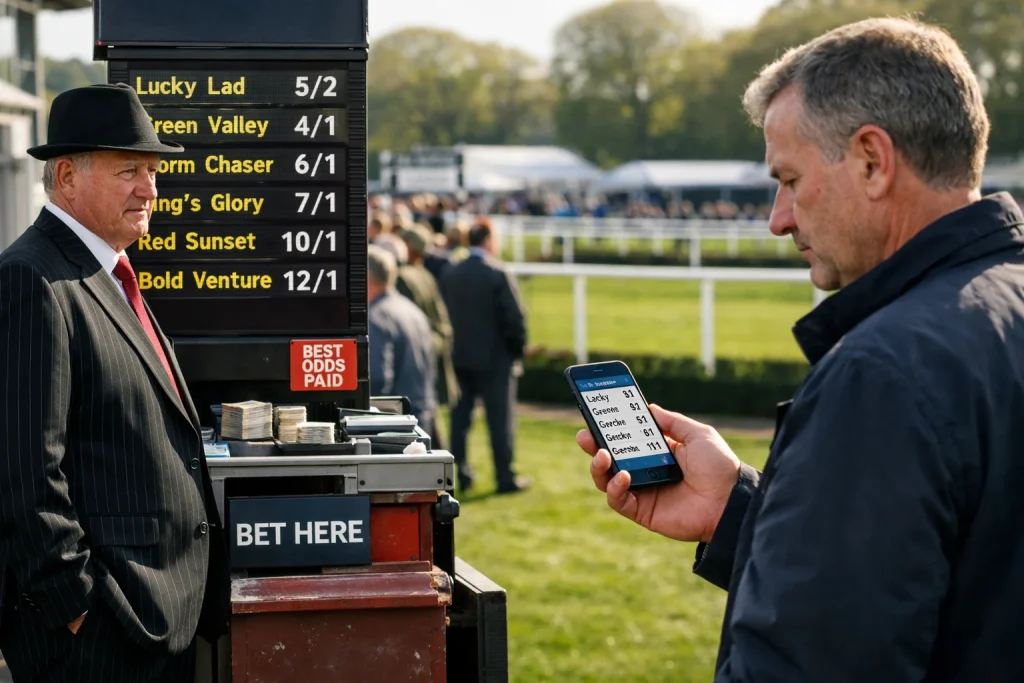
Fixed Odds vs Starting Price: When to Take the Price in Horse Racing
The decision between fixed odds and Starting Price sits at the heart of horse racing betting strategy. Lock in a price early, or wait and accept whatever odds are available when the race begins? This choice confronts every punter before every bet, and getting it consistently right separates profitable bettors from those who leave money on the table.
Fixed odds offer certainty. You see the price, you accept it, and that price determines your return regardless of subsequent market movements. Starting Price offers patience. You defer the pricing decision until the moment the race starts, accepting the consensus view of on-course bookmakers as the market closes. Each approach suits different circumstances, and blind adherence to either costs money over time.
What makes this decision particularly challenging is its asymmetric nature. When you take fixed odds and the SP drifts higher, you feel the sting of missed value. When you take SP and the price contracts, you receive less than was available hours earlier. Neither outcome feels like a win, even when the horse wins the race. The psychological burden of timing decisions can overwhelm the underlying question of whether the bet offers value at all.
This analysis cuts through the uncertainty with a data-driven approach to the fixed odds versus Starting Price question. By understanding the mechanics of both options, recognising the market conditions that favour each, and deploying modern tools like Best Odds Guaranteed, you can make the right call at the right time. The goal is not perfection – no one predicts every price movement – but systematic advantage that compounds across hundreds of betting decisions.
Understanding Fixed Odds
Fixed odds become “fixed” at the moment your bet is accepted. The price displayed when you confirm your stake is the price you receive, regardless of how the market subsequently moves. This certainty represents the fundamental appeal of fixed odds betting: you know exactly what you stand to win before the race begins.
Horse racing markets typically open with early prices – often overnight or early morning quotes that bookmakers use to stimulate market activity. These prices reflect initial assessments based on available form, going conditions, and historical patterns. As betting progresses through the day, prices adjust to reflect incoming money and information. Horses attracting support see their odds contract, while those ignored by the market often drift to longer prices.
Early prices tend to exhibit the greatest volatility. A horse quoted at 8/1 overnight might be 5/1 by mid-morning and 3/1 by race time if money floods in. Alternatively, it might drift to 12/1 as support fails to materialise. The morning market represents a period of price discovery, where bookmakers probe public sentiment and adjust accordingly. Taking fixed odds during this volatile period locks in prices that may look brilliant or terrible by race time.
Afternoon prices, particularly those available in the hour before a race, tend toward greater stability. The market has absorbed most available information, major money has been placed, and prices reflect a more settled consensus. Fixed odds taken during this period involve smaller potential discrepancies with the eventual Starting Price, reducing both the upside and downside of the timing decision.
The timing of your fixed odds bet therefore determines your relationship with market volatility. Early bets carry greater variance – the price you lock in may diverge substantially from SP in either direction. Late bets reduce variance but also limit opportunities to capture value from price movements. Neither approach is inherently superior; the optimal timing depends on your assessment of likely price direction and your tolerance for timing risk. Understanding this trade-off matters more than ever: according to the HBLB Annual Report 2026-25, average betting turnover per race fell by approximately 8% year-on-year and 19% compared to 2021/22, indicating thinner markets where timing decisions can have amplified consequences.
Understanding Starting Price
Starting Price represents the official industry odds at which bets are settled when no fixed price was taken. The SP is determined by on-course bookmakers at the moment the race begins, providing a snapshot of market conditions as the stalls open or the tape rises. This figure reflects the final consensus of professional opinion on each runner’s chances.
The mechanics of SP determination involve designated SP reporters who observe the odds displayed by on-course bookmakers at each meeting. These reporters calculate a representative price from the range of available odds, excluding outliers and accounting for market depth. The resulting Industry SP is then applied to all bets settled at Starting Price.
On-course markets differ meaningfully from online markets. Course bookmakers operate with physical pitches and boards, adjusting prices in response to betting at the track and intelligence about off-course money. Their prices often diverge from those shown on betting apps, sometimes significantly. A horse available at 6/1 online might be 5/1 or 7/1 with course bookmakers, and the SP reflects the on-course reality rather than online pricing.
For punters seeking SP alternatives, Betfair Starting Price offers a compelling option. BSP is calculated from matched bets on the Betfair exchange at race time, providing a market-based SP that often differs from Industry SP. The numbers are striking: according to analysis from Geegeez, BSP beats Industry SP in 97.5% of races when comparing 2023-2026 UK racing data. This near-universal advantage reflects the deeper liquidity and competitive dynamics of exchange markets compared to traditional on-course bookmaking.
Why such a consistent difference? Industry SP is derived from on-course markets where bookmakers must manage their positions across all runners. They often shade odds to protect against liability, resulting in prices that slightly undervalue expected returns. Exchange markets, by contrast, match backers directly with layers in a competitive environment that tends to produce more efficient prices. The result benefits punters who take BSP over Industry SP.
SP betting suits circumstances where you lack confidence in price direction or simply want to delegate the timing decision to the market. By accepting SP, you receive whatever odds the market settles upon, avoiding both the anxiety and the potential regret of timing decisions. This passive approach has merit when you believe the market is likely to price the race efficiently by post time.
When Fixed Odds Beat SP
Fixed odds outperform SP when prices shorten during the betting period. The classic scenario involves a “steamer” – a horse whose price contracts significantly from morning to post time. Taking fixed odds early captures value that disappears as money floods into the market, often leaving late backers and SP punters with significantly worse returns.
Market confidence provides the clearest signal of likely shortening. When strong ante-post support continues into day-of-race betting, prices typically contract further. A horse backed from 10/1 to 6/1 in ante-post markets often sees continued support on race day, potentially finishing at 4/1 or shorter. Taking 6/1 in the morning protects against this continued contraction.
Information asymmetries drive many price contractions. Trainers, owners, and stable staff possess knowledge about horses that the public market lacks. When a trainer targets a specific race or a horse shows exceptional home work, this information gradually flows into the market through various channels. Early prices may not reflect this private knowledge, but race-day betting eventually does. Punters who identify likely beneficiaries of informed money can capture value by taking prices before the information becomes public.
Certain race types exhibit predictable shortening patterns. Unexposed maidens from powerful yards often attract late support as connections signal confidence. Well-handicapped horses returning from breaks may shorten as paddock observers note their condition. Small-field races with obvious contenders often see favourites compressed as the market eliminates alternatives.
The distinction between Premier and Core fixtures matters here. BHA data shows betting turnover on Premier fixtures grew by 1.1% in 2026, while Core fixtures saw an 8.1% decline. Higher-profile meetings attract more sophisticated money, often resulting in sharper price movements. The horses that attract early support at Newmarket’s July Meeting or York’s Ebor Festival may see dramatic shortening as professional money dominates the market.
Case studies illustrate the dynamic. A well-bred maiden from a leading flat yard, showing prominently in morning markets at 7/2, might start at 6/4 favourite after attracting support from connections and informed followers. Taking 7/2 captures value unavailable to anyone betting within an hour of the race. Similarly, a horse returning from a wind operation, available at 8/1 in the morning, might drift to 6/1 early as the market doubts the improvement, then contract to 4/1 as connections place their bets. Early identification of likely support delivers substantial edge.
When SP Beats Fixed Odds
SP outperforms fixed odds when prices drift during the betting period. “Drifters” – horses whose odds lengthen from morning to post time – reward patience. Taking SP on a horse that opens at 5/1 but starts at 8/1 delivers 60% better returns than locking in the morning price.
False favourites present classic drifting scenarios. A horse might attract early support based on reputation, recent form, or speculative connections gossip, only to lose backing as more careful analysis reveals weaknesses. The initial price reflects hype; the SP reflects reality. Betting SP on horses you suspect are over-backed early captures the market’s correction.
Market overreaction to superficial factors creates drifters. A horse dropping in class might attract early support from casual punters who see the pattern without deeper analysis. If the form book reveals the horse actually drops into a competitive handicap rather than an easier spot, the price often drifts as serious money ignores the selection. Similarly, horses switching from all-weather to turf, or vice versa, sometimes attract support from punters who fail to account for surface preferences. The market corrects these errors by race time.
Weather-dependent selections frequently drift when conditions change. A horse requiring soft ground might be well-backed in the morning based on forecast rain, then drift dramatically if the weather clears. Taking SP allows conditions to stabilise before you commit to a price. If the rain arrives, you still get decent odds on a horse now suited by the going. If conditions improve, you can reconsider or take the drifted SP on a horse whose conditions have not materialised.
Large competitive fields often see widespread drifting as the market struggles to identify clear contenders. In a 20-runner handicap, multiple horses might attract morning support before the market recognises that no single selection deserves favouritism. Prices across the board drift as each fancied runner finds opposition. Taking SP in such races means accepting the market’s final assessment rather than betting against its eventual consensus.
Exchange alternatives amplify the SP advantage. As noted by Sporting Life, BSP typically offers around 10% more value than Industry SP. If you intend to take SP regardless, directing your bets through an exchange rather than a traditional bookmaker captures this additional edge. The combination of market drift and exchange efficiency can deliver substantially better returns than early fixed odds with traditional bookmakers.
Late money often proves the most informed money. Professional punters and informed connections frequently delay their bets until close to race time, both to avoid influencing the market and to incorporate final information about going, paddock appearance, and betting signals. Aligning with this sophisticated late money, by taking SP, means your settlement reflects the views of the most informed participants rather than earlier, potentially less accurate assessments.
BOG as the Solution
Best Odds Guaranteed eliminates much of the timing dilemma by providing asymmetric protection. When you take fixed odds with a BOG bookmaker, you receive whichever price proves higher – your fixed odds or the SP. If the price drifts, you get SP. If it shortens, you keep your fixed odds. The downside of timing errors disappears while the upside is preserved.
The strategic implication is powerful: with BOG protection, taking early prices becomes almost universally preferable to waiting for SP. You cannot receive worse than SP, so the only risk is opportunity cost – the possibility that you might have found an even better early price elsewhere. Against a single bookmaker’s market, BOG turns the fixed odds vs SP question into a one-sided proposition.
BOG performs optimally when you genuinely cannot predict price direction. If you believe a horse will drift, waiting for SP might still make sense – though BOG means the cost of being wrong about drift is zero. If you believe a horse will shorten, BOG provides insurance while capturing the early price. For selections where price direction is uncertain, BOG removes the question entirely.
The exceptions matter. Ante-post bets fall outside BOG coverage, leaving the timing decision genuinely consequential for long-range wagers. Certain meetings and markets may be excluded depending on bookmaker terms. Enhanced promotional odds sometimes forfeit BOG protection. In these scenarios, the fixed odds vs SP analysis retains full significance, and you must assess price direction without the safety net.
Combining BOG with line shopping across multiple bookmakers approaches optimal strategy. Take the best available early price with a BOG bookmaker, secure in the knowledge that drift will be captured while contraction will not harm you. If another bookmaker offers a significantly better price without BOG, the calculus becomes more complex – but for most bets at most odds, the BOG-protected bookmaker offering competitive prices provides the best expected outcome.
BOG has shifted the fixed odds vs SP debate fundamentally. Where once the timing decision involved genuine trade-offs and required predictive skill, BOG allows punters to consistently favour early prices without bearing timing risk. Make the right call at the right time – and with BOG, the right time is almost always early.
A Practical Decision Framework
Converting the fixed odds vs SP analysis into practical decisions requires a systematic framework. Rather than approaching each bet ad hoc, a structured checklist improves consistency and reduces the mental burden of repeated timing decisions.
The first filter is BOG availability. If your intended bet qualifies for Best Odds Guaranteed, the decision often resolves immediately: take the early price with protection. The only reasons to deviate are significantly better odds elsewhere without BOG, or specific circumstances where you have strong conviction about drift. For most bets, BOG bookmakers offering competitive prices deserve the action.
Without BOG, assess race type and field dynamics. Maidens and novice races with unexposed runners exhibit high price volatility. Large-field handicaps often see generalised drift. Small-field conditions races tend toward sharper, more confident markets. Pattern races attract professional money that moves prices efficiently. Each race type carries different timing characteristics that inform the fixed odds vs SP choice.
Consider the specific horse’s profile. Is this a runner with strong connections who might attract late support? Does the horse have specific requirements – ground, distance, draw – that might become clearer closer to race time? Has the horse been backed before when trained well, suggesting connections play the market actively? These factors indicate likely price direction.
Market signals matter. A horse showing morning support that continues into mid-morning probably continues contracting. A horse that attracted overnight backing but has drifted since markets opened may have found its level. Sharp, confident money arriving on a single selection usually continues, while widespread small bets across multiple runners often dissipates. Watching early market behaviour provides clues about subsequent direction.
The broader market context affects all decisions. “The horse population continues to decline and the betting environment remains challenging,” observed Richard Wayman, Director of Racing at the BHA. This challenging environment means markets sometimes behave erratically as liquidity reduces. Thin markets can see exaggerated price swings, amplifying both the potential upside and downside of timing decisions. In these conditions, BOG protection becomes even more valuable.
Finally, consider your own information and confidence. If you have identified a selection through careful analysis and believe the market underestimates its chances, taking early value makes sense. If you are following tips or playing hunches without deep analysis, the market may price the horse more accurately than your initial interest, making SP more sensible.
The framework collapses to a simple hierarchy: take BOG where available, favour early prices when you expect shortening or lack directional view, favour SP when you expect drift and lack BOG protection, and use BSP as a superior alternative to Industry SP when exchange betting is practical.
The Exchange SP Alternative
Betting exchanges offer a distinct alternative to both traditional fixed odds and Industry SP through the Betfair Starting Price. BSP represents the price at which your bet is matched on the exchange at the moment of the race start, providing a market-based alternative to on-course SP that consistently delivers better value.
The statistical evidence for BSP advantage is overwhelming. Analysis of 2023-2026 UK racing data shows BSP outperformed Industry SP in 97.5% of races. This near-universal superiority reflects fundamental structural differences between exchange and on-course markets. Exchange matching creates competitive pressure that on-course bookmakers, managing their own positions and profit margins, cannot replicate.
Using BSP involves placing a “Take SP” bet on the exchange, which matches at the prevailing price when the race begins. Unlike traditional SP bets, you retain control until race time – you can cancel, adjust your stake, or take an in-play price if you change your mind. This flexibility combines with superior pricing to make BSP the logical choice for punters comfortable with exchange betting.
Commission affects net returns but rarely eliminates the BSP advantage. Standard exchange commission runs between 2% and 5% on winning bets, deducted from profits. Even after commission, BSP typically returns more than Industry SP in the vast majority of races. For active exchange users who earn reduced commission rates through high turnover, the advantage widens further.
BSP works particularly well for horses likely to attract late exchange activity. Popular selections often see prices compress on the exchange as race time approaches, while less fancied runners may drift. The exchange SP captures this final market view, incorporating all available information and betting activity up to the moment of the off.
Integration with fixed odds strategy involves recognising when BSP represents the best available option. If you cannot take early fixed odds with BOG protection, and you lack strong conviction about price direction, BSP provides a superior alternative to both Industry SP and taking late fixed odds that may already reflect the market’s final view. The 97.5% advantage rate makes BSP the default choice when traditional SP is the alternative.
Practical considerations include exchange account requirements, minimum stake thresholds, and the need to understand exchange mechanics. For punters who already use exchanges, directing SP bets through BSP rather than traditional bookmakers represents low-hanging value. For those new to exchanges, the learning curve is modest and the long-term benefit substantial.
The fixed odds vs Starting Price decision no longer needs to generate anxiety or second-guessing. With a clear framework and the right tools, you can approach timing decisions with confidence rather than uncertainty.
The hierarchy is clear. BOG protection makes early fixed odds preferable in most circumstances. When BOG is unavailable, assess race type, horse profile, and market signals to determine likely price direction. If you expect drift and must take SP, use BSP rather than Industry SP to capture the consistent exchange advantage.
Make the right call at the right time. With systematic thinking and appropriate use of available tools, timing decisions become a source of edge rather than stress. The market rewards punters who understand its mechanics and position themselves accordingly.